
 By Fast Pass Admin
Getting behind the wheel for the first time is a mix of excitement and nerves. The journey from a provisional to a full UK driving licence is a significant milestone, but it comes with a steep learning curve. The key isn't just learning how to operate a car; it's about developing the awareness, skills, and mindset to navigate Britain's busy roads safely and confidently. Many new drivers focus solely on the manoeuvres needed to pass the test, but true driving mastery goes much deeper. It involves understanding traffic flow, anticipating the actions of others, and staying calm under pressure.
This guide provides essential, practical tips for new drivers, moving beyond the obvious advice to offer actionable strategies that will help you not only pass your test but also become a safer, more skilled driver for life. We will explore techniques used by advanced drivers, from mastering spatial awareness with proper mirror checks to managing your state of mind to avoid road rage. Our goal is to give you the tools to handle any situation the road throws at you with poise. For those eager to accelerate their learning, intensive courses can provide the structured, focused environment needed to embed these habits quickly and effectively. Let's begin building your confidence on the road.
1. Master the Three-Second Rule for a Safer Following Distance
One of the most fundamental yet critical skills in driving is maintaining a safe following distance. The ‘Three-Second Rule’ is a simple, dynamic method to ensure you always have enough space to react and brake safely. This technique is a cornerstone of defensive driving, actively promoted by leading UK road safety organisations like the Driver and Vehicle Standards Agency (DVSA) and RoSPA.
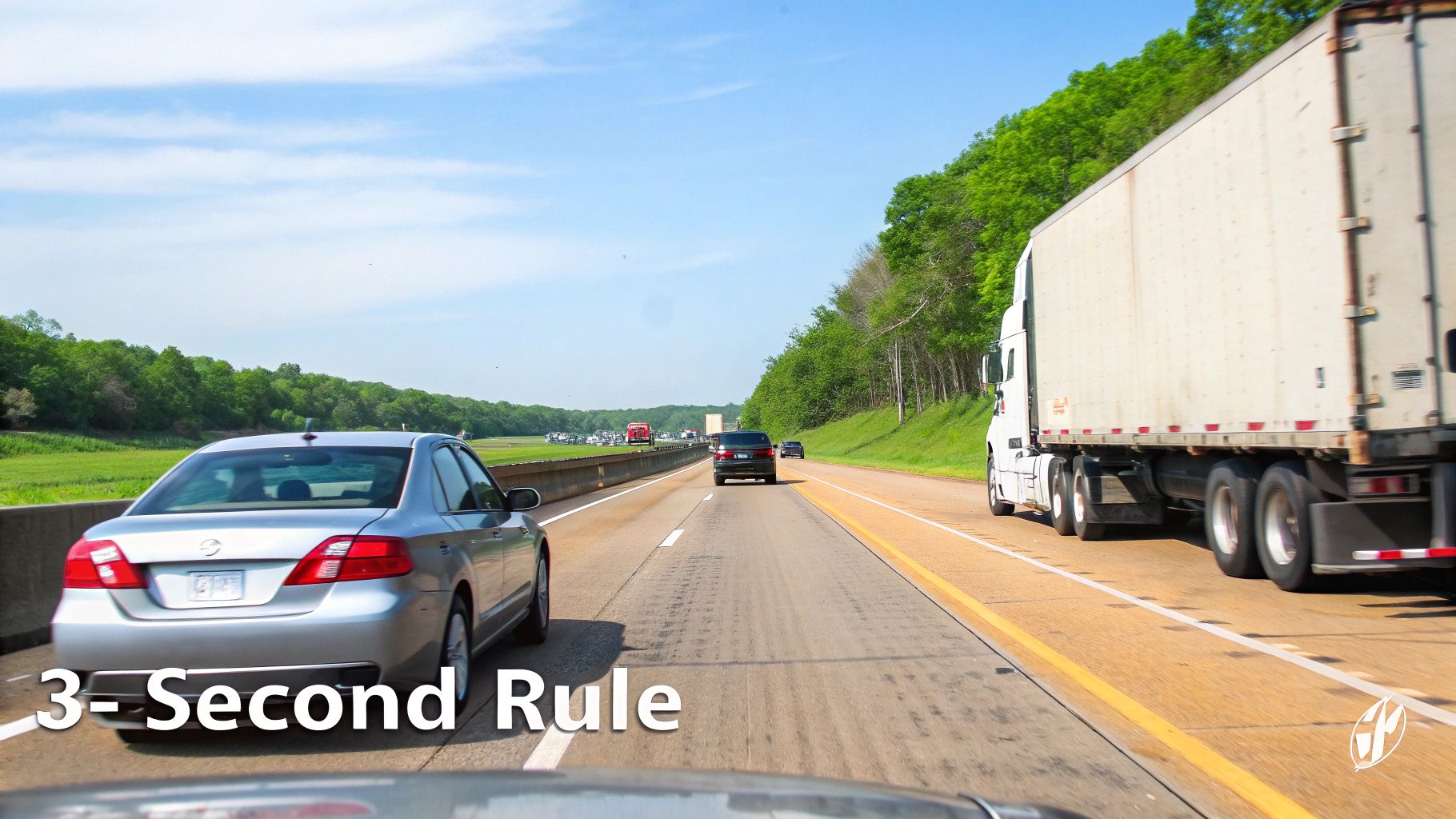
The method is brilliant in its simplicity. As the vehicle ahead of you passes a fixed object, like a lamppost, sign, or bridge, start counting: 'one-thousand-one, one-thousand-two, one-thousand-three.' If your car reaches that same object before you finish counting, you are following too closely and need to ease off the accelerator.
Why It Works So Well
This technique naturally adjusts for your speed; the faster you travel, the more distance you cover in three seconds, automatically creating the buffer you need. This space accounts for your reaction time (thinking distance) and your car's braking distance. For new drivers, consistently applying this rule builds a crucial habit that significantly reduces the risk of front-to-rear collisions, the most common type of accident on UK roads.
Key Insight: A three-second gap isn't just empty space; it's your personal safety zone. At 70 mph on a motorway, it provides a buffer of approximately 96 metres, while in a 30 mph urban zone, it's about 40 metres.
How to Implement the Rule Effectively
- Choose Clear Markers: Use stationary objects that are easy to spot, such as road signs, trees, or bridge supports. Avoid using moving objects or shadows.
- Count Out Loud: When you're first learning, verbally counting makes the process a conscious habit. It forces you to actively monitor your distance rather than relying on guesswork.
- Adapt to Conditions: This is one of the most vital tips for new drivers. The three-second rule is a minimum for dry conditions. In wet or icy weather, you must double this to at least a six-second gap to account for reduced tyre grip and longer stopping distances.
- Stay Calm and Readjust: If another vehicle merges into your gap, don't get frustrated. Simply ease off the accelerator and re-establish your three-second cushion behind the new vehicle. Protecting your own safety zone is your priority.
2. Check Your Blind Spots Every Single Time
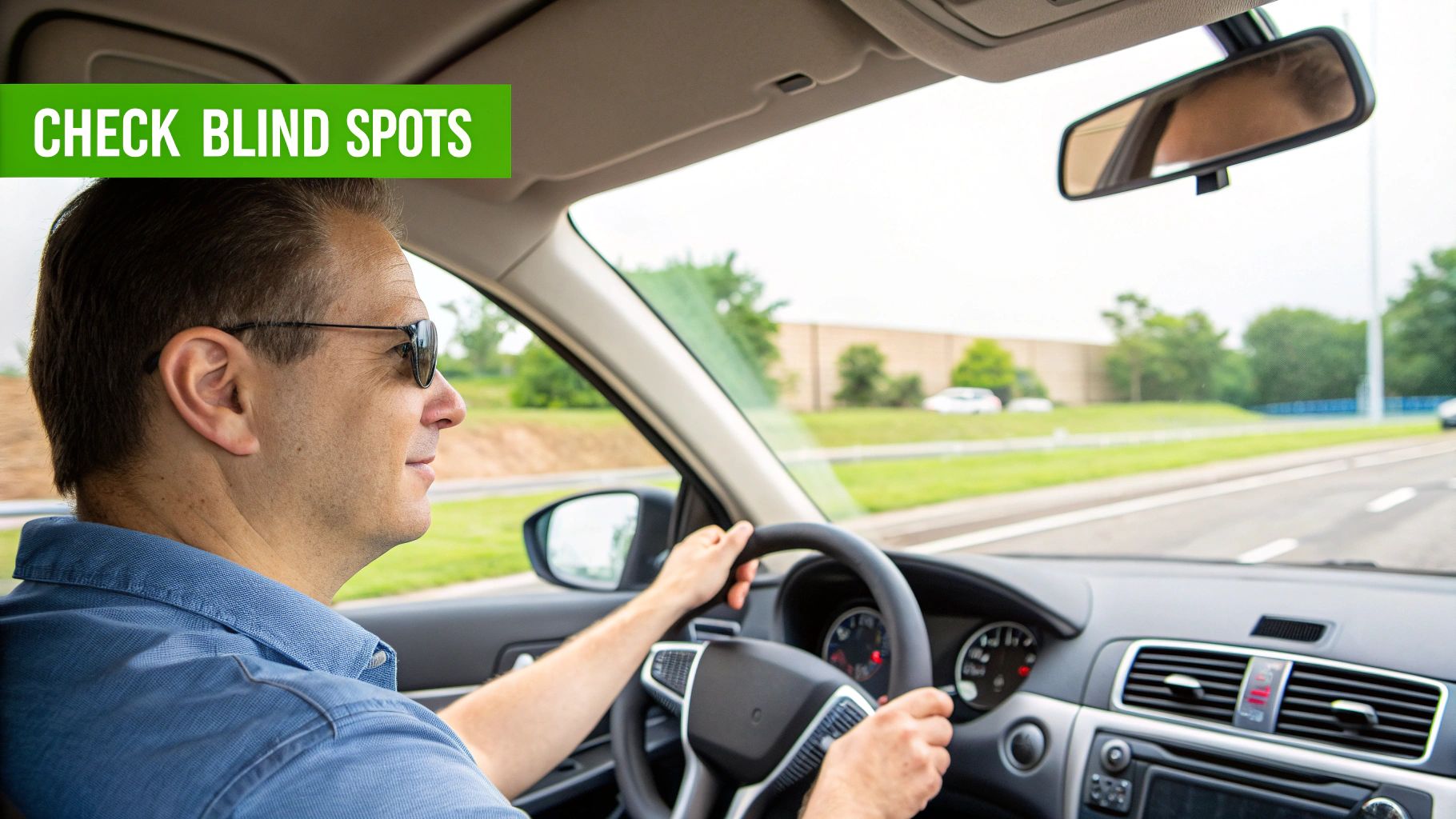
Relying solely on your mirrors creates a dangerous false sense of security. Every car has blind spots, areas around the vehicle that cannot be seen in the side or rearview mirrors. A physical head check, looking over your shoulder into the area you intend to move into, is a non-negotiable safety action. This habit, championed by driving safety bodies like the Insurance Institute for Highway Safety (IIHS) and professional instructors, is a critical defence against side-swipe collisions.
Checking your blind spot is the crucial link between seeing a space and safely moving into it. It’s the final confirmation that the lane is clear before you change lanes, merge with traffic, or pull away from the kerb. This simple head turn can reveal a car, motorcyclist, or cyclist hidden from your mirrors, preventing a potentially devastating accident.
Why It's a Lifesaver
Mirrors provide a good, but incomplete, picture of the road around you. A vehicle that was far behind you can accelerate quickly and enter your blind spot just as you decide to change lanes. For new drivers, the act of physically checking this space trains the brain to build a complete 360-degree awareness of the traffic environment, moving beyond just looking forward. This is one of the most vital tips for new drivers to internalise, as it directly prevents one of the most common causes of merging accidents.
Key Insight: Your mirrors show you what was happening, but a blind spot check shows you what is happening right now, in the space you are about to occupy. It’s the difference between prediction and confirmation.
How to Implement the Habit Flawlessly
- Create a Mantra: Embed the "Mirror-Signal-Blind Spot-Manoeuvre" sequence into your driving routine. Say it out loud before every lane change or turn until it becomes second nature.
- Adjust Mirrors First: Before you even start the engine, adjust your mirrors correctly to minimise the size of your blind spots. While it won't eliminate them, proper adjustment gives you the best possible view.
- Be Quick but Thorough: A blind spot check isn't a long stare. It's a quick, decisive glance over your shoulder. Keep your chin up and turn your head about 90 degrees. You don't want to drift out of your lane while you're checking.
- Show Extra Vigilance: Be particularly aware of smaller road users. Motorcyclists and cyclists are much easier to miss and can easily be hidden in a blind spot. Always assume one could be there, especially at junctions or in heavy traffic.
3. Keep Your Eyes Moving and Scan Ahead
A common mistake for new drivers is developing ‘tunnel vision’ by fixating on the car directly in front. Instead, you should cultivate ‘Eagle Eyes’ by actively scanning your entire driving environment. This technique, championed by advanced driving organisations and commercial driver training programmes, involves continuously moving your eyes to anticipate hazards long before they become immediate threats.
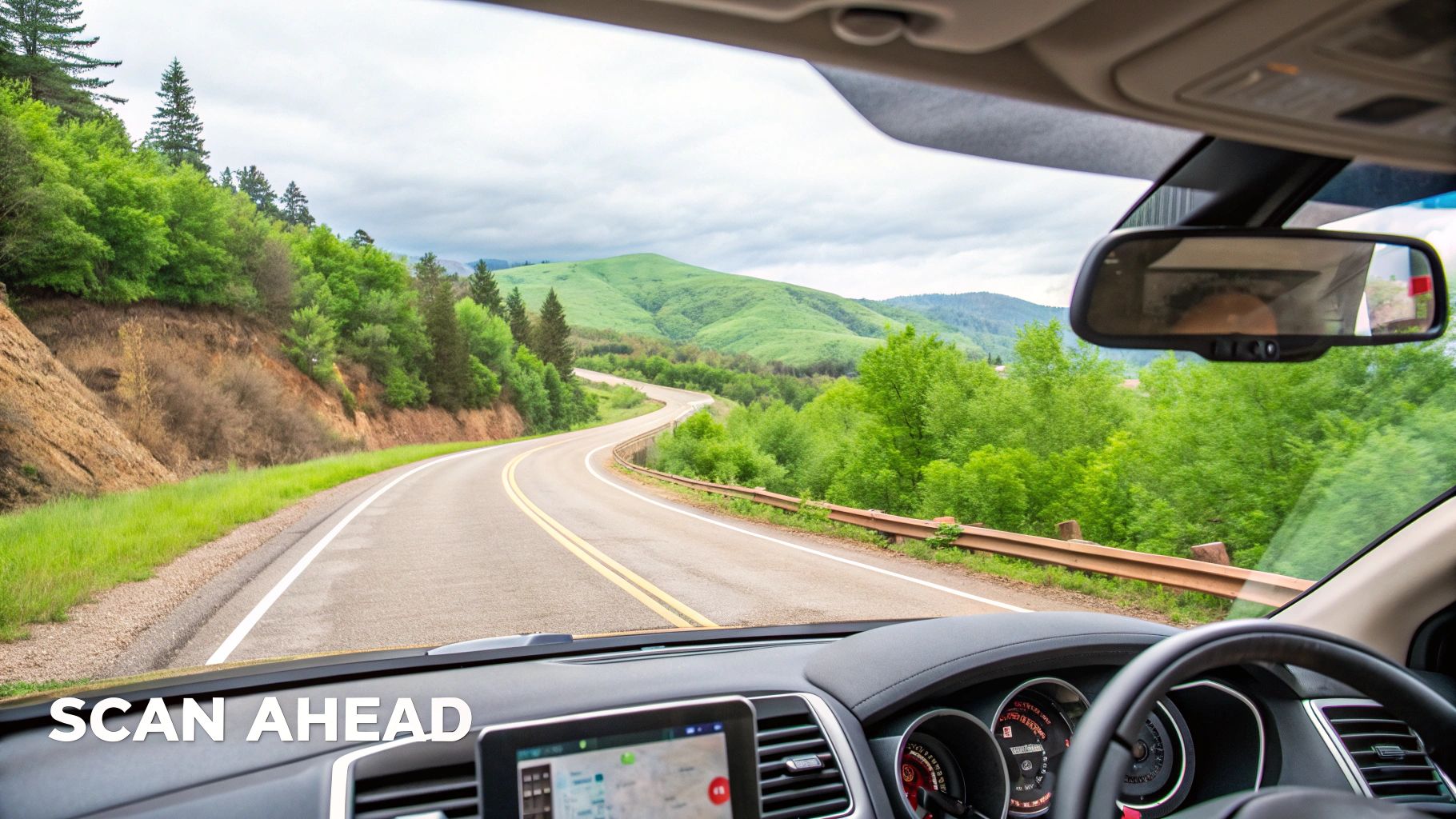
This proactive approach means monitoring the road 12-15 seconds ahead, checking your mirrors every 5-8 seconds, and being aware of everything happening around your vehicle. It’s about seeing the bigger picture, not just the bumper in front. By constantly scanning, you give yourself the time and space to react smoothly and safely, transforming from a reactive driver into a predictive one. Mastering this skill is a crucial step for any new driver looking to build confidence and competence.
Why It Works So Well
Active scanning prevents you from being surprised by sudden events. When you spot a potential hazard early, such as brake lights several cars ahead or a cyclist preparing to merge, you can make gentle adjustments to your speed and position. This reduces the need for sudden braking or sharp steering, leading to a smoother, safer, and more fuel-efficient drive. It's a fundamental part of the hazard perception skills you need to pass your test and is one of the most effective tips for new drivers to stay safe.
Key Insight: Aim to look 12-15 seconds into your path of travel. In a 30 mph zone, this means looking about a block and a half ahead; on a 60 mph A-road, you should be looking nearly half a kilometre down the road.
How to Implement Scanning Effectively
- Practise the Smith System: This proven method involves five key principles: Aim high in steering, get the big picture, keep your eyes moving, leave yourself an out, and make sure they see you.
- Don't Fixate: Avoid staring at any single object for more than two seconds. Consciously move your gaze from the road ahead, to your rearview mirror, to your side mirrors, and back again.
- Check Mirrors Before Changing: Before you signal, slow down, speed up, or turn, make a mirror check a non-negotiable habit. This ensures you always know what’s happening behind and beside you.
- Enhance Your Vision: Maintaining excellent visual awareness is paramount. For improved visibility and to truly master your 'Eagle Eyes' in low-light conditions, explore how to enhance your night vision for safer roads. Developing your ability to spot dangers is a key part of your hazard perception practice.
4. Always Use Your Turn Signals
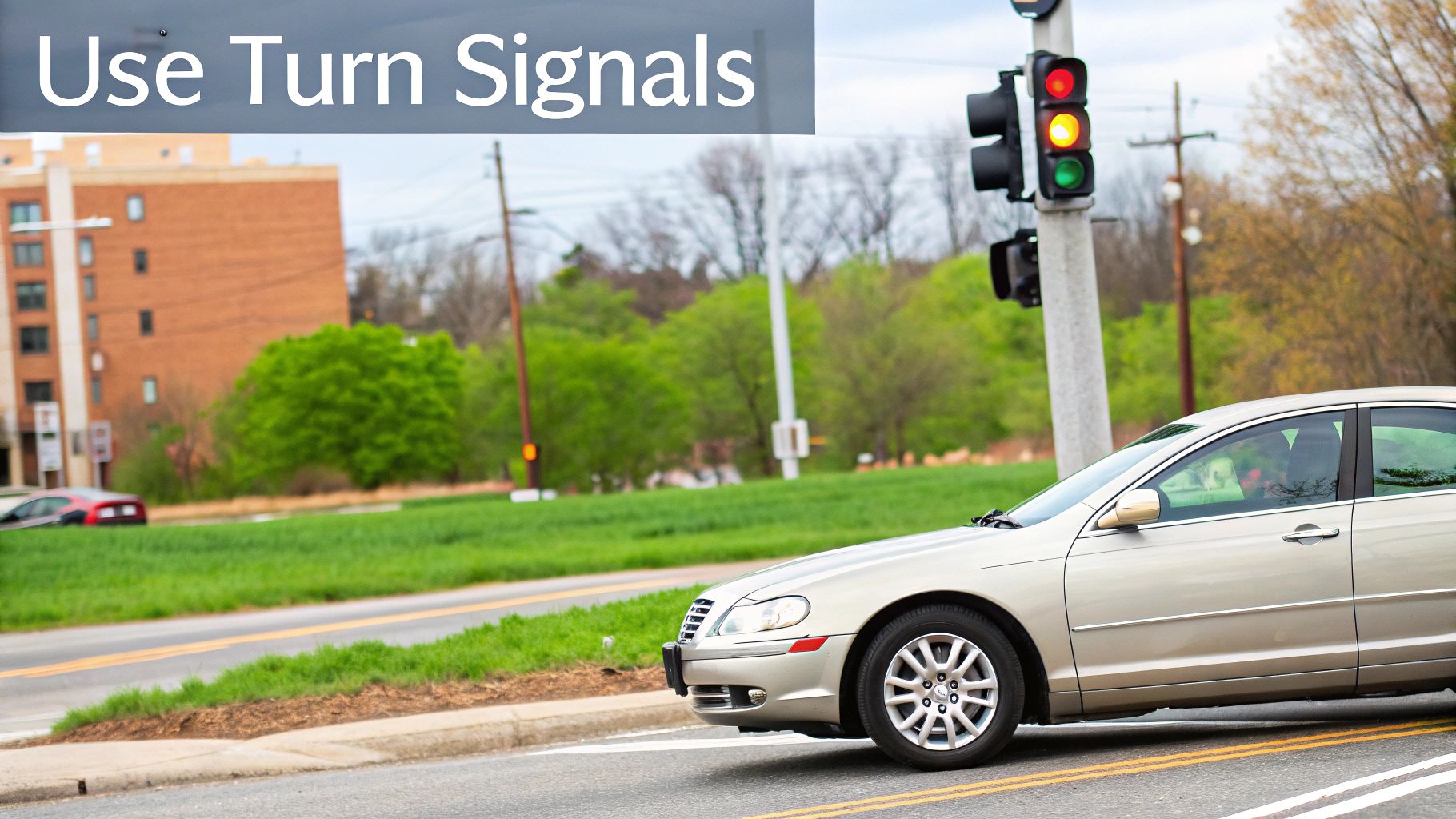
Your turn signals are your vehicle's language, your primary method of communicating your intentions to other road users. Using them correctly and consistently is not just a legal requirement but a fundamental aspect of cooperative and safe driving. This simple habit prevents confusion, reduces accidents, and helps maintain a smooth traffic flow by allowing drivers, cyclists, and pedestrians to anticipate your next move.
The principle is straightforward: signal your intent to turn or change lanes well in advance. This gives everyone around you sufficient time to see your signal, understand what you plan to do, and adjust their own driving accordingly. For new drivers, turning this action into an automatic, non-negotiable habit is one of the most impactful tips for new drivers you can adopt, preventing countless near-misses and collisions.
Why It Works So Well
Signalling removes guesswork from the driving equation. When you indicate your intention to change lanes on a busy motorway, you give the driver in the adjacent lane the vital information they need to either slow down to let you in or maintain their speed to let you merge behind them. It turns a potentially hazardous manoeuvre into a predictable and coordinated action. Similarly, signalling a turn alerts pedestrians at a crosswalk that you are about to cross their path, preventing dangerous situations.
Key Insight: Think of your indicator as speaking to other road users. Neglecting to signal is like suddenly changing direction in a crowded hallway without a word; it’s bound to cause chaos and potential collisions.
How to Implement the Rule Effectively
- Make It an Automatic Habit: The goal is to signal for every single turn and every single lane change, without exception. This includes manoeuvres in car parks or on quiet streets where you think no one is around. Building the muscle memory is key.
- Time It Right: The Highway Code advises you to signal in good time. A good rule of thumb is to signal at least 30 metres (about 100 feet) before your turn in urban areas and for a longer duration on high-speed roads like motorways and dual carriageways.
- Check for Cancellation: After completing your turn or lane change, ensure your indicator has cancelled automatically. A forgotten, blinking signal can be just as confusing and dangerous as no signal at all.
- Perform Bulb Checks: Regularly check that all your indicator bulbs are working. A burned-out bulb makes your signals useless and can lead to a fine and points on your licence. This is a crucial part of basic vehicle maintenance.
5. Stay Calm and Avoid Road Rage
Maintaining emotional control behind the wheel is a critical, yet often overlooked, driving skill. Road rage isn't just about aggressive gestures; it's a dangerous loss of control that can lead to collisions. For new drivers, learning to manage the stress of traffic, delays, and other road users' actions is as important as mastering clutch control. Organisations like the AAA Foundation for Traffic Safety highlight that aggressive driving is a factor in a significant number of serious accidents.
The key is to proactively manage your mindset, separating your emotional reactions from your driving decisions. When another driver cuts you off or a slow vehicle holds you up, the goal is to respond with calm, defensive action rather than anger. This approach protects you, your passengers, and everyone else on the road by keeping a predictable and safe environment.
Why It Works So Well
A calm driver is a focused driver. When you prevent frustration from taking over, you maintain your cognitive ability to anticipate hazards, judge distances, and react appropriately. Anger narrows your focus and increases risk-taking behaviour, such as tailgating or making rash decisions at junctions. By staying composed, you remain in full control of the most important part of the car: you.
Key Insight: Treat other drivers’ mistakes as hazards to be avoided, not personal insults. You have no idea what is happening in their car or their life; your only job is to navigate the situation safely.
How to Implement the Rule Effectively
- Plan Ahead to Reduce Pressure: One of the biggest triggers for stress is running late. Always allow extra time for your journey, which removes the pressure to rush and makes you less susceptible to frustration from traffic.
- Practice the 'Golden Rule': Drive how you would want others to drive around you. Be courteous, let people merge, and avoid unnecessary use of the horn. This fosters a less confrontational driving environment. If driving anxiety is a major concern, considering specialised driving lessons for nervous drivers can provide targeted strategies.
- Don't Engage: If you encounter an aggressive driver, the safest action is to de-escalate. Avoid eye contact, do not react with gestures, and create distance by slowing down or changing lanes to let them pass.
- Develop Your Mental Resilience: Your car is not a soundproof bubble for venting. In addition to managing immediate stress, developing the ability to build mental toughness to thrive under pressure can significantly help you maintain composure on the road. This long-term skill is one of the most valuable tips for new drivers.
6. Adjust Your Mirrors and Seat Properly
Before you even turn the key, one of the most vital safety checks is ensuring your vehicle is correctly set up for you. Proper seat and mirror adjustment is not about comfort alone; it's a fundamental aspect of car control, visibility, and reaction time. Leading safety bodies, such as the Insurance Institute for Highway Safety (IIHS), stress that this initial setup is a critical step in preventing accidents.
A correct driving position ensures you can operate all controls effectively, from the steering wheel to the pedals, without stretching or straining. Paired with optimally aligned mirrors, this setup drastically minimises blind spots and provides a comprehensive view of your surroundings. For new drivers, mastering this pre-drive routine builds a professional habit that underpins all other driving skills.
Why It Works So Well
This meticulous setup directly impacts your ability to control the vehicle and react to hazards. A proper seat position allows you to depress the brake pedal fully and swiftly in an emergency, while correct mirror alignment gives you the crucial information needed to make safe lane changes and manoeuvres. Getting this right reduces physical fatigue on longer journeys and enhances your spatial awareness, making you a more confident and observant driver.
Key Insight: Your car's cockpit is your command centre. Taking 30 seconds to adjust it properly transforms your vehicle from a generic box into a tailored extension of your own body, maximising control and situational awareness.
How to Implement the Rule Effectively
Getting your setup right is a simple, sequential process. Follow these steps every time you get into a different car, or if someone else has driven yours. For a more in-depth guide, you can learn more about how to adjust your mirrors and seat properly.
- Adjust Your Seat First: Your seat position dictates your relationship with all other controls. Adjust the height so your eyes are at the halfway point of the windscreen. Move the seat forward or back so you can fully press the clutch and brake pedals with a slight bend in your knee. Finally, adjust the backrest so your arms are slightly bent when holding the steering wheel.
- Set Your Rear-View Mirror: Position your main rear-view mirror so that it frames the entire rear windscreen. You should be able to see directly behind you without needing to move your head, only your eyes.
- Align Your Side Mirrors: This is a key tip for new drivers. Adjust your wing mirrors outwards until you can just see the side of your own car. This technique, often promoted by advanced driving organisations, significantly reduces the size of your blind spots.
- Check and Re-check: Mirrors can be knocked out of position easily. Make it a habit to glance at them and confirm their alignment before setting off on any journey. Your safety depends on the clear, accurate information they provide.
7. Practice Defensive Driving
Beyond the mechanical skills of operating a car, defensive driving is a crucial mindset that transforms you from a passive operator into a proactive guardian of your own safety. It's a driving philosophy based on the assumption that other road users may make mistakes. This forward-thinking approach, championed by institutions like RoSPA and the National Safety Council, prepares you to anticipate and react to potential hazards before they escalate into emergencies.
The core principle is to manage the space around your vehicle and always have a plan. Instead of simply reacting to events as they unfold, you actively scan for potential problems, such as a car waiting to pull out from a side road or a pedestrian near a crossing. This is one of the most essential tips for new drivers because it builds a habit of awareness and caution from the very beginning of your driving career.
Why It Works So Well
Defensive driving significantly lowers your risk profile by teaching you to identify and mitigate dangers early. You learn to see the road not just as it is, but as it could be in the next few seconds. This involves constantly asking "what if?" What if the car in front brakes suddenly? What if that cyclist swerves? This proactive thinking gives you the time and space needed to avoid collisions, even when others make unpredictable moves.
Key Insight: Defensive driving isn't about being timid; it's about being smart and in control. It empowers you to manage risks created by others, moving you from a position of vulnerability to one of command over your immediate environment.
How to Implement This Mindset Effectively
- Always Have an 'Out': Constantly assess your surroundings to ensure you have an escape route. This could be the hard shoulder, an empty adjacent lane, or a gap in traffic you can move into if the vehicle ahead stops abruptly.
- Drive to the Conditions, Not the Limit: The speed limit is a maximum, not a target. In rain, fog, heavy traffic, or near schools, a responsible defensive driver reduces their speed to match the increased risk, ensuring they have adequate time to stop.
- Avoid Blind Spots: Be hyper-aware of other vehicles' blind spots, especially those of lorries and buses. If you can't see the driver in their mirror, they can't see you. Either speed up or slow down to remain visible.
- Position for Visibility: Make sure other drivers can see you. Use your headlights in overcast or low-light conditions, even during the day. Position your car in your lane to give yourself the best possible view of the road ahead and make yourself conspicuous to others.
7 Essential Tips for New Drivers Comparison
| Safety Technique | Implementation Complexity 🔄 | Resource Requirements ⚡ | Expected Outcomes 📊 | Ideal Use Cases 💡 | Key Advantages ⭐ |
|---|---|---|---|---|---|
| Follow the 3-Second Rule | Low – simple counting method, easy to apply | Minimal – requires only focus | Reduces rear-end collisions by up to 40% | Highway and city driving at moderate to high speeds | Provides automatic speed-adjusted safe distance |
| Check Your Blind Spots | Moderate – requires physical head movement | None, but needs neck mobility | Prevents up to 75% of lane-change accidents | Changing lanes, merging, urban & highway traffic | Detects hidden vehicles, improves spatial awareness |
| Keep Your Eyes Moving and Scan Ahead | Moderate to High – requires continuous scanning | None, needs mental focus & practice | Identifies hazards early, improves reaction times | Long distance driving, complex environments | Prevents fatigue, improves situational awareness |
| Always Use Your Turn Signals | Low – simple mechanical action | None | Reduces accidents by clear communication | All turns and lane changes across all driving scenarios | Legally required, prevents confusion and road rage |
| Stay Calm and Avoid Road Rage | Moderate – requires emotional self-control | None, personal effort | Prevents aggressive incidents and related accidents | Stressful, congested, or aggressive traffic | Reduces stress, improves safety and enjoyment |
| Adjust Your Mirrors and Seat Properly | Low to Moderate – one-time setup, occasional adjustment | None, but requires time and knowledge | Maximizes visibility, reduces blind spots | Before driving, especially when switching drivers | Improves comfort, safety, and reaction time |
| Practice Defensive Driving | High – requires ongoing alertness and strategy | None, mental engagement required | Significantly lowers accident risk and insurance | All driving conditions, especially complex or risky | Builds hazard recognition and confidence |
Putting It All Together on Your Road to Success
Becoming a proficient and self-assured driver is a journey, not a final destination. While passing your practical driving test is a monumental achievement, the real learning curve begins the moment you trade your L-plates for P-plates. The foundational tips for new drivers we’ve explored are not merely clever tricks to impress an examiner; they are the essential building blocks for a lifetime of safe, responsible driving.
From diligently applying the three-second rule to consistently checking your blind spots, each piece of advice works in concert to create a robust system of awareness and control. These aren't isolated actions but interconnected habits. For instance, keeping your eyes moving and scanning ahead (Tip #3) directly supports your ability to practice defensive driving (Tip #7), allowing you to anticipate hazards long before they become immediate threats. Similarly, correctly adjusting your mirrors (Tip #6) is pointless if you don't use them to check your blind spots (Tip #2).
From Theory to Muscle Memory
The true value of these principles is realised when they transition from conscious thought to automatic behaviour. This is where consistent, deliberate practice becomes paramount. Every single time you get behind the wheel, make a conscious effort to:
- Scan your environment: Actively look far ahead, check your mirrors frequently, and be aware of what's happening at junctions and pedestrian crossings.
- Communicate your intentions: Use your indicators for every turn, lane change, or roundabout exit, giving other road users ample warning.
- Manage your space: Maintain a safe following distance and be mindful of the space around your vehicle, giving yourself room to manoeuvre.
- Maintain your composure: Acknowledge that other drivers will make mistakes. Focus on your own actions and reactions rather than getting drawn into frustration or road rage.
Mastering these habits transforms driving from a stressful, reactive task into a calm, proactive experience. You will find your confidence grows not from a lack of challenges on the road, but from your proven ability to handle them safely and effectively.
Your Next Steps on the Road
Think of these tips as your core curriculum. Your next step is to put them into practice relentlessly until they become second nature. If you find certain areas challenging, focus your practice sessions on them specifically. Perhaps dedicate one drive to focusing purely on smooth braking and another on mastering roundabout positioning. By committing to these fundamental practices, you are investing in your own safety and the safety of everyone you share the road with. You are not just learning the mechanics of operating a car; you are developing the mindset of a truly competent driver.
Ready to fast-track your journey from learner to licensed driver with confidence? The intensive and semi-intensive programmes at Fast Pass Driving Courses are designed to embed these essential skills quickly and effectively under the guidance of expert instructors. Explore our tailored courses and book your assessment lesson today at Fast Pass Driving Courses to start your journey.